

A POS terminal (Point Of Sale/Service) allows merchants to accept payments by debit and/or credit card. It electronically transfers funds from customers’ cards to the merchant’s account. The terminal is installed in the customer service area of the merchant’s premises. A telephone line (used only for the duration of the transaction) and an electricity supply are required. Alternatively, our bank offers mobile POS terminals that use GSM / GPRS communication.
An Automated Teller Machine (ATM), commonly known in Bulgaria as a cash machine, is an electronic terminal where you can withdraw cash, change your card PIN, check the balance of your account and transfer money between your card account and another account in your name, in either direction. The technology also allows a range of other functions.
Point of Sale (POS) is an electronic terminal that accepts a bank card to initiate and authorise a payment transaction. It enables direct cashless payment for goods or services at a merchant.
Bank cards are accepted at electronic terminals (ATMs and POS terminals). These devices electronically read the card and cardholder data from the magnetic stripe or chip, and transactions are processed online.
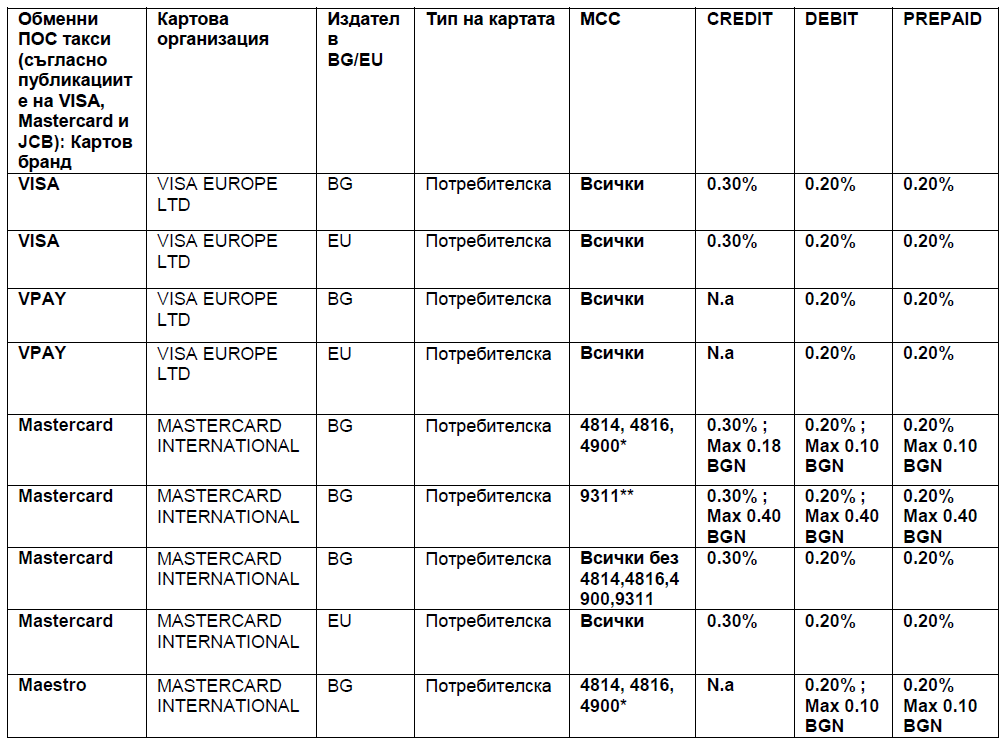
In accordance with Regulation (EU) 2015/751 of the European Parliament and of the Council of 29 April 2015 on interchange fees for card-based payment transactions, D Commerce Bank, as a payment service provider within the Union, provides its customers with information on the interchange fees applied to each transaction between the issuer and the acquirer involved in a card-based payment transaction.
In accordance with Chapter I, Articles 1,2, and Chapter II, Articles 3, 4, 6 and 12, the information provided concerns payment transactions carried out within the Union where both the payer’s and the payee’s payment service providers are located in the Union. It does not cover:
a) transactions with commercial cards;
b) cash withdrawals from ATMs or at the counter of a payment service provider; or
c) transactions with payment cards issued by three-party payment card schemes.
Request received
A colleague will contact you to confirm the appointment.


